
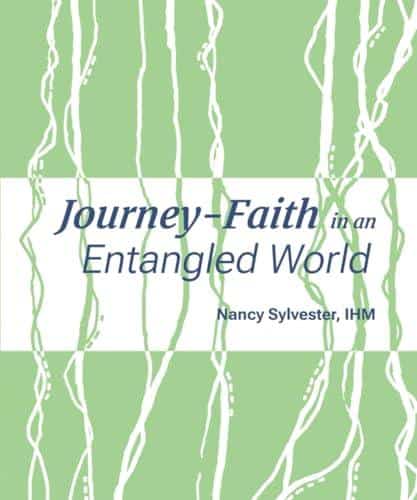
Journey-Faith in an Entangled World, Institute for Communal Contemplation and Dialogue
Nancy Sylvester, IHM, Journey-Faith in an Entangled World, Institute for Communal Contemplation and Dialogue, 2024, 179 pages; Amazon, paperback $18.95, Kindle $11.99
Reviewed By Mary E. Hunt
New times demand new spiritualities. Nancy Sylvester, IHM, offers just that in Journey-Faith in an Entangled World. It is a book to which I return often for insight and how-to techniques for contemplative prayer in desperate times. I do not expect magic solutions, much less final answers. But I need and value this useful contribution to the long history of Christian spirituality as a contemporary treasure.
What’s new is quantum physics, evolution, AI, and the welcome voices of people of color, women, non-binary people, young activists, and old peacemakers all seeking to make sense of and give meaning to life. What’s old is most of the spiritual practices that ground Christian faith which are replete with a male-model divinity, a top-down structure of church and community, and a very narrow sense of whose views matter. In the old dispensation, spirituality was hoarded as if the practice of prayer and meditation belonged to a spiritual elite and not to everyone. Nancy upends that.
She offers something fresh and vital, grounded in the Christian tradition but encompassing a cosmic reality that knows no boundaries. It is as if she were on a recent lunar trip and came to see things from the other side of the moon, what contemplatives call ‘a long loving look at the real’. Such seeing is not automatic, she counsels, but the fruit of regular, preferably daily or twice daily time set aside for contemplation. Just how to do that in the midst of busy lives is the first challenge.
Contemplative prayer is a touchstone with the divine. It is a feeble human effort to balance the urge to do with the wit to be. Nancy shows the way in this book. She leaves blank “Spaciousness to Create” pages for the reader to fill in, a sure sign that this is not a cookie-cutter approach but one that each person tailors for themselves.
Nancy came to this work from the busy, buzzy halls of Congress. She was a researcher and lobbyist at NETWORK Lobby for Catholic Social Justice, an organization founded in 1971 by women from religious congregations. She served as NETWORK’s National Coordinator/Executive Director for ten years. She went on to leadership in her religious community, the Sisters, Servants of the Immaculate Heart of Mary, and was active in the Leadership Conference of Women Religious of which she was a president.
Nancy saw up close the makings and machinations of government and church, where progress is slow and backlash is powerful. Without sustaining spirituality, few people persist in the work of justice and the dream of peace. In her LCWR Presidential Address in August 2000, she stressed the problem of impasse and the helpfulness of contemplation: “I believe we are at an impasse and that nothing less than contemplation which touches into our deepest core and stirs our God-given creativity will help us to imagine new ways of responding in love. And, that we must do individually and together.”
This analysis, coming from a dedicated activist, rings true and grounds all of Nancy’s work. When the spiritual resources available are insufficient to the task, new ones are necessary. People who work on seemingly impossible tasks like Roman Catholic women’s ordination, anti-racism, non-violence, poverty, and the issues that require more than a lifetime to change must be sustained somehow. Nancy recognized the moment and got busy making an important contribution to social change through spirituality.
Nancy founded the Institute for Communal Contemplation and Dialogue in 2002, inspired by the writings and teachings of Constance FitzGerald, OCD. Her initial project was “Engaging Impasse,” a series of contemplative weekends that trained scores of people in the rudiments of contemplation and respectful, generous ways to talk with one another across differences.
Techniques include poetry, music, the arts in many forms, as well as a strong focus on nature, body movement, and silence, just silence. The key is to enter into the silence together—whether in person, virtually, or even telepathically. Intentional sitting for contemplation is an ancient and multi-religious practice; its fruits are as fresh as the dawn. Equally important is the communal dialogue dimension, a time for sharing insights and ideas that emerge from deep and trustworthy wells, both personal and communal. None of it is easy, but such practices can only help in today’s moral morass.
This book is the distilled wisdom of Nancy’s practice. Using an art exhibit as the metaphor, she leads the reader through seven galleries with contemplation as the medium on display. Whether sparked by music or an object, whether sitting in nature or at home, the possibilities of contemplation are endless. Try sitting in silence with your class before a session, with your community group at the beginning of a meeting, with your book club as a starter. Note how very different the quality of the subsequent dialogue often is because of this way of being together.
We at the Women’s Alliance for Theology Ethics and Ritual (WATER) are used to dealing with impasses. So following Nancy’s lead, we initiated a monthly meditation practice, first in person and later on Zoom, to help us cope with the challenges. The group is always open to new participants and has revolving leadership. The foundation laid by Nancy’s approach has stood us in good stead. Her wisdom is now available between soft covers. This book makes a welcome gift for committed activists seeking spiritual sustenance. It is an investment in the common good that depends on all of us, body and spirit.
Mary Hunt, Ph.D. is the co-founder and co-director of WATER, in Silver Spring, Maryland.