
Follow-up to WATERmeditation, Monday, October 15, 2025 at 7:30 PM ET
Mary E. Hunt, “Shaping a Full Life”
Using Mary Oliver’s “When Death Comes” from New and Selected Poems, Boston: Beacon Press, 1992
Mary E. Hunt led the October 13, 2025 WATERmeditation “Shaping a Full Life” using Mary Oliver’s “When Death Comes” from Mary Olivers’s New and Selected Poems, Boston: Beacon Press, 1992.
We were happy to welcome Vera Logose, our new Brethren Voluntary Service colleague. Vera is from Ft. Worth, TX, and comes to WATER following a stint with the Notre Dame Mission Volunteers in partnership with AmeriCorps in Boston. We appreciate her work.
At our last meeting, in July 2025, BVS colleagues from Germany, Wed Naji and Magdalena Müller, prepared a meditation to remember the goodness of summer. They invited us to think about and share stories and memories of our childhood summers that we hold dear. They promised it would be ‘epic’ and proclaimed it was by the very presence of each and every one! The video can be found at https://www.youtube.com/watch?v=WPzHaLOtogc
Our customary land acknowledgment followed on this day just after Canadian Thanksgiving and U.S. Indigenous Peoples’ Day.
Introduction
Mary E. Hunt in the co-founder and co-director of WATER, a feminist theologian and ethicist with special interest in liberation of those who are most marginalized. Her remarks follow.
“Shaping a Full Life”
My topic is death for which I am aided by the great poet Mary Oliver whose poem concludes my remarks.
I do not intend for us to have a morbid, morose reflection on death despite the Day of the Dead, All Saints, and All Souls Days coming at month’s end.
Nor am I avoiding the reality of death. I was assigned to lecture about the passage from Romans 6:9 “death shall have no more dominion” at a retreat at Kirkridge. I announced, to the contrary, that death has all the dominion in the world. My respondent, the great Catholic gay Jesuit theologian John J. McNeill, whose centenary we celebrate this year, fairly ran to the podium to explain just how wrong I was.
Death, he was sure, had no dominion and we will all live happily ever after. I was and am not so sure. I explained that as a feminist, I subscribe to the equally great theologian Rosemary Radford Ruether’s notion that when we die we will all be composted into the great Matrix of Life, whatever shape that takes. John was horrified by the thought of becoming compost. He was quite sure that when he died, he would be “Little Jackie McNeill” running into the arms of his Abba/father God.
I observed the gendered nature of even our ideas about death—women seeing eternity as a collective experience, and every man for himself. But more significantly, I was struck by how our different ideas of death shape so much about how we live, think, decide in life.
John and I eventually agreed to disagree. We decided that we would all find out in good time, hopefully not that day! Then we went on to worship and dinner. Death is like that—there are no final answers until the final answer, and that doesn’t help much in such debates.
I invite us to ponder our full, vigorous lives, and use the unsettled, and I think unsettable, question of death as a chance to focus on how we wish to shape our lives from beginning to end. What do we want to do and not do? Whom and what do we want to embrace? Whom and what do we reject? What do we cherish and what are we glad to see fade away?
A dear friend passed away a few weeks ago. Just after she died, her partner asked me to be with her at the bedside until the funeral personnel arrived. When I got there within the hour, the body was still warm. When the body left, it was cold. When we saw it for the last time at the mortuary a day later, it was frozen. Death is real like that, dominating for sure. But as the body chilled, our memories of our friend warmed. Life, not death, has dominion over some things like love.
I am in the process of updating my will. That sobers you up on the reality of death which is part of the whole package we call life. Decisions for a will are best made while one is upright, mobile, compos mentis, and of good cheer. In doing the mundane tasks of assigning responsibilities to others to handle things when I am dead, in deciding to whom my earthly possessions will go, how I want my body disposed of, where and in what form it will be buried, there are rich life choices to be made. They are about how to live now and how others will live when I no longer exist. I embrace all of these choices as life in its fullness, the whole palette of life.
The Canadian Medical Assistance in Dying (MAiD) has been a great catalyst for important discussions in families and communities about what individuals want for the end of their lives. I want to talk with people about those issues as part of my living and dying well. I think end of life issues are as important as, say, abortion. Choice is choice.
Let Mary Oliver, the great American poet, inspire us as we move into meditation. I will read her poem “When Death Comes,” and Vera has picked some images that will be on the screen during the silence to remind us of her words.
Let Mary Oliver and me invite you to “Shape Your Own Full Life,” make your own choices. Then we will leave as we came: alone, loved, and full of grace.
Poem 102: When Death Comes, by Mary Oliver
New and Selected Poems, Beacon Press, 1992.
When death comes
like the hungry bear in autumn;
when death comes and takes all the bright coins from his purse
to buy me, and snaps the purse shut;
when death comes
like the measle-pox;
when death comes
like an iceberg between the shoulder blades,
I want to step through the door full of curiosity, wondering:
what is it going to be like, that cottage of darkness?
And therefore I look upon everything
as a brotherhood and a sisterhood, {ED addition: and a siblinghood}
and I look upon time as no more than an idea,
and I consider eternity as another possibility,
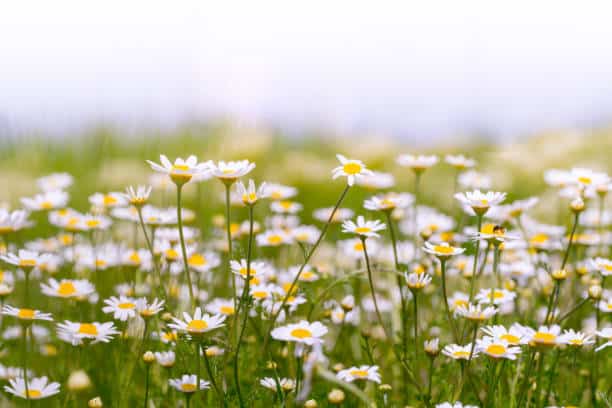
and I think of each life as a flower, as common
as a field daisy, and as singular,
and each name a comfortable music in the mouth,
tending, as all music does, toward silence,
and each body a lion of courage, and something
precious to the earth.
When it’s over, I want to say: all my life
I was a bride married to amazement.
I was the bridegroom, taking the world into my arms.
When it’s over, I don’t want to wonder
if I have made of my life something particular, and real.
I don’t want to find myself sighing and frightened,
or full of argument.
I don’t want to end up simply having visited this world.
With these beautiful and helpful words, let us enter into contemplation on how we want to shape our full lives.
Meditation Time with photos of autumn, field daisies, and a solitary canoeist reminiscent of some of Mary Oliver’s images


Sharing in person, in the chat, and in subsequent emails.
- A former hospice chaplain remarked on how much he loved this poem. As a Benedictine Oblate, he is urged to keep death “daily before your eyes,” something he has come to appreciate. With Mary Oliver, he affirmed that living in the past with regret is not good, nor is living in the future with uncertainty, or even with hope. But it is good to live in the present with a deep awareness and a sense of gratitude.
- The denial of death is common. Ernest Becker’s The Denial of Death (1973) is a useful book on the topic. One participant is looking into a green burial for herself and will report later on her findings. Green burials are becoming popular for women religious. For example, the Sisters of Mercy in Omaha, Nebraska have that option.
- Death Cafes are gatherings of people to discuss end of life issues in full and frank terms. One participant has led such sessions. See https://deathcafe.com/. One of their promotional lines is “Talking about death won’t kill you!”
- Aquamation is a new option for disposal of bodily remains. It combines heat, water, and an alkaline solution for breaking down the body with very low impact on the environment.
- One participant spoke of not having been a bride, but is now thinking of resurrecting her great grandmother’s gold wedding band to wear as a symbol of being “a bride married to amazement.” Great idea!
- Another person shared that as a widow, she still wears her wedding band as “a symbol of the marriage of the divine feminine and masculine.” Lovely.
- A person is taking classes in keening, a Gaelic practice of wailing for the dead. She recommended reading materials by Phyllida Anam-Aire, especially her 8 week course, https://weavingremembrance.org/keening-2025/.
Thanks to all participants. See you on Mon. Nov. 3, 2025 with Brad Lutz leading on “Honoring Our Guiding Lights.”
